Basics of Cells
We've all heard of cells as the "building blocks" of life. But what exactly do they do?
What's in a cell?
Cells are the fundamental building blocks of our body. Each cell has various components, such as the nucleus (which stores DNA), cytoplasm (fluid where cellular activities occur), and cell membrane (a protective outer layer).
Understanding DNA and Genes
DNA, short for deoxyribonucleic acid, functions like a recipe book holding instructions necessary for building. Specific sections of DNA, called genes, provide instructions for a specific protein.
Nucleotides are the basic building blocks of nucleic acid (RNA & DNA). A nucleotide consists of a sugar molecule bonded to a phosphate group and a nitrogen-containing base. The sugar of one nucleotide bonds to the phosphate of the next, creating a sugar-phosphate backbone. The basis stick out and carry the actual genetic code.
In DNA, two of these strands pair up to form the famous double helix. In RNA, it's usually a single strand as it needs to be flexible (fold into different shapes) to perform its functions - like carrying instructions from DNA to make proteins.
DNA and RNA molecules are polymers made up of long chains of nucleotides. Polymers are macromolecules (a very large molecule) made up of many repeating smaller units called monomers. In the case of DNA & RNA, the monomers are the nucleotides.
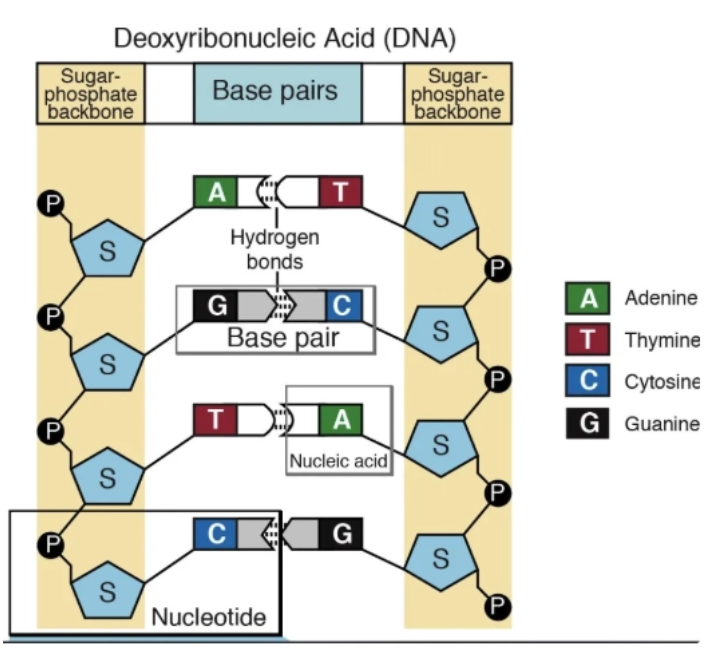
The four chemical bases used in DNA are: adenine (A), guanine (G), cytosine (C), and thymine (T). The sequence of these bases is what codes for genes, and changing just one base can lead to a mutation.
DNA bases pair up with each other using hydrogen bonds, A with T, C with G, to form units called base pairs.
In school, we learn that *all cells contain exactly the same DNA. After all, every human body started out from a single cell - a fertilized egg. This cell develops into all kinds of cell types: skin cells, liver cells, blood cells...
*This is not 100% accurate, as we'll cover later.
DNA Replication
One of the most fundamental features of DNA is it can replicate itself. DNA is a double helix made of two complementary strands: So if one strand is A-T-G-C, we know the opposite strand is T-A-C-G. This means each strand has all the information needed to rebuild the other.
But how does this "rebuilding" take place?
- An enzyme called helicase breaks the hydrogen bonds between the base pairs. These two DNA strands separate, like unzipping a zipper
- Each strand acts as a template. Another enzyme, DNA polymerase, builds a new strand by matching complementary nucleotides to each template strand. This happens simultaneously on both strands.
- Two identical DNA molecules are formed, with each original strand pairing with a new daughter strand.
What makes a cell different?
Different cells "turn on" (express) different sets of genes to make proteins. The set of genes expressed in a cell determines the set of proteins and functional RNAs it contains, giving it its unique properties.
For example, one of the jobs of the liver is to remove toxic substances like alcohol from the bloodstream. To do this, liver cells express genes encoding subunits of an enzyme called alcohol dehyrogenase. This enzyme breaks alcohol down into non-toxic moleucule. On the other hand, neurons in a person's brain don't remove toxins from the body, so they keep these genes unexpressed, or "turned off."
This act of controlling which genes to turn "on" at the right time is known as gene regulation.
What is gene expression and regulation?
Gene expression is the process by which information encoded in a gene is used to make a functional product, usually a protein.
The two main steps in gene expression are transcription (DNA -copied-> mRNA) and translation (mRNA -assembled-> protein).
Gene regulation is the process by which cells control the expression of genes. It determines when, where, and how much of a gene's product is made.
Gene transcription
- In the nucleus, the cell's machinery copies the gene sequence into messenger RNA (mRNA). mRNA encodes a polypeptide (a chain of amino acids)
- Like DNA, mRNA has four nucleotide bases - but the base uracil (U) replaces thymine (T), giving us: adenine (A), uracil (U), guanine (G), cytosine (C)
- mRNA moves from the cell nucleus to the cell cytoplasm, where it is used for synthesizing the encoded protein
Gene translation
For translation to happen, we need ribosomes and tRNAs.
- Ribosomes provide a structure in which translation can take place, and catalyze the reaction that links amino acids to make new protein
- tRNAs (transfer RNAs) carry amino acids to the ribosome. They act as "bridges," matching a codon in an mRNA with the amino acid it codes for.
Ribosomes
- Ribosomes (found in the cytoplasm) are the molecular machines that read the mRNA sequence and assemble amino acids into a polypeptide chain.
- Ribosomes consists of two major components: small and large ribosomal subunits.
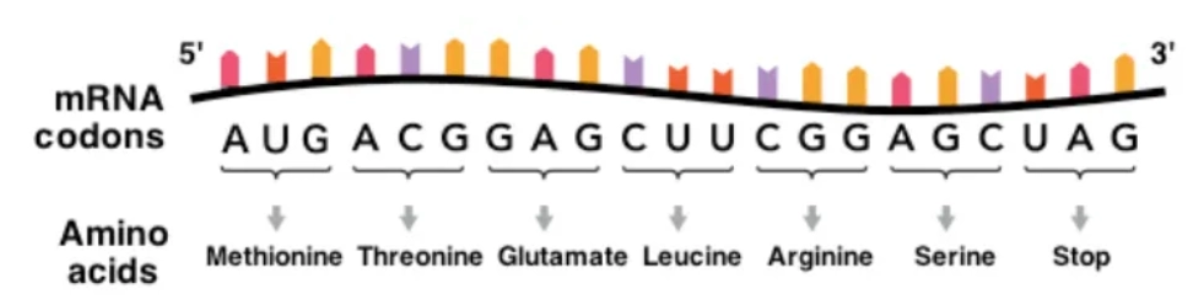
- In mRNA, the instructions for building a polypeptide are RNA nucleotides (A,U,G,C) read in groups of three, called codons.
- Each codon is read to specify a single amino acid. These amino acids are linked together (via peptide bonds formed by the ribosome) in a specific order to form a polypeptide. A protein is made up of one or more of these polypeptides.
- mRNA doesn't carry the amino acid itself - it just tells which amino acids are needed. It is tRNA which physically carries that amino acid, based on codon-anticodon matching
- The sequence of amino acids, known as the primary structure of a protein, determines how the polypeptide folds into a specific three-dimensional shape. This folded shape dictates the protein's function - whether it acts as an enzyme, hormone, structural component, etc.
tRNA
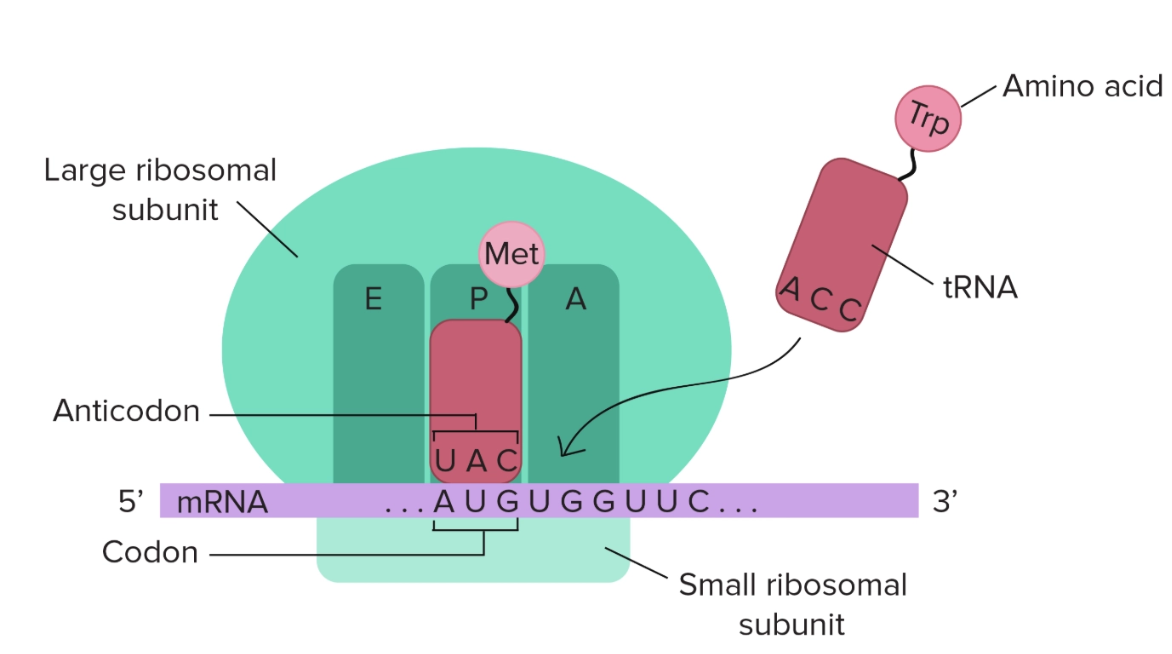
- Each tRNA has an anticodon that's complementary to a codon on the mRNA (e.g. mRNA has AUG codon, and tRNA has complementary UAC anticodon)
- Each tRNA also carries an amino acid. Specifically, the one encoded by the codons that the tRNA binds to.
- The tRNA "reads" the mRNA by base-pairing with its codon and delivers the correct animo acid to the growing chain.
Example
Say our mRNA strand has the following sequence near the beginning:... | AUG | GGU | UUU | ...
- This is read by the ribosome during translation. Each group of three letters is a codon, and AUG is always the start codon
- The AUG codon codes for the amino acid Methionine (Met)
- A specific tRNA comes in withAnticodon: UAC (complementary to AUG codon)Attached amino acid: Methionine
- The ribosome locks the tRNA into lace. It then waits for the next codon (GGU) and the corresponding tRNA (anticodon=CCA, amino acid=glycine)
- Once the two tRNAs are in place, the ribosome forms a peptide bond between Methionine and Clycine. We now have the start of a polypeptide chain:
Methionine - Glycine - ...
Junk DNA
DNA contains instructions (coding) that are used to create proteins in cells. However, not all of the genetic sequences present within a DNA molecule actually code for a protein - these noncoding regions of DNA are called junk DNA.
In the human genome, only 2% of the genome is coding. What about the rest of the 98% junk DNA?
These "junk" DNA actually play important roles, whether it's determining the 3D architecture of DNA, or how it folds. These non-coding regions also contain sequences that are known to affect gene activity, meaning there are regulatory elements within them.
So, why don't all cells share the same DNA?
There are a few instances where this is the case:
- Adaptive immune cells: Our bodies anticipates the huge diversity of infectious agents by pre-emptively shuffling bits of DNA around to make millions of different receptors, to try to recognize as many diffferent antigens as possible
- Red blood cells: They lose their nucleus and mitochondria (and thus all their DNA) as they mature
- Polypoids: Some cells can have more copies of the usual genetic material than other cells
- Infection: DNA content of cells can be changed by being infected by viruses or intracellular bacteria. This can be temporary - until the pathogen leaves/gets killed by immune system. It can also be permanent - particularly true for certain viruses which establish latent infections, like some herpesviruses which can exist as an episome (mostly foreign DNA which can exist independently of the host cell's DNA, or integrate into it), or retroviruses like HIV which insert their DNA into the host cell's genome)